
Chasing Summer Stone
Summer can feel like a fickle season for boulderers. Heat and humidity torch friction at lower elevations, yet the urge to get outside only grows stronger with longer days. The antidote is altitude—or latitude—and a willingness to travel. From the aspen-lined valleys of southwest Colorado to the orange sandstone of South Africa’s Cederberg, the following four destinations deliver crisp conditions, inspiring vistas, and enough problems to keep your project list stocked for years.
Telluride, Colorado
High Alpine Diversity at 9,000 feet and Beyond
Climate & Season
Wedged into a glacial box canyon ringed by 13- and 14-thousand-foot peaks, Telluride’s boulders sit between 7,000 and 11,300 feet. Daytime highs rarely top the low 70s °F (21 °C) even in July, while thin, dry air supercharges friction. Afternoon monsoon storms blow through quickly; plan sessions for crisp mornings and golden-hour evenings.
Stone & Style
Five distinct rock types—quartzite, sandstone, granite, conglomerate, and volcanic tuff—offer a sampler platter of movement: compression on river-polished cobbles, fingertip crimps on bullet granite, and gymnastic roof climbing on overhanging sandstone.
Must-Climb Classics
- Mogul Area: Upstream Arete V4—an elegant prow above the river.
- Priest Lake: Wheels on the Bus V7—steep rail pulls in a shady grotto.
- Alta Lakes: Bear Necessities V10—high-elevation crimp test-piece with stunning views of Mount Wilson.
Guidebook & Beta
The new 2024 Telluride Bouldering guide by Christian Prellwitz documents 900+ problems (550 freshly added) across six never-before-mapped zones, with GPS-linked maps and local history (rockandresole.com). Mountain Project supplements updates between printings.
Logistics & Challenges
Trailheads are minutes from town, but most blocs sit between 7 000 and 11 300 ft, so give yourself time to acclimatize. Approaches are short but often brutally steep. Camping: true free “dispersed” options have been replaced by designated, no-fee sites at Mary E and Priest Lake or the paid Alta Lakes campground; vehicle camping is illegal in Mountain Village. Pack layers—summer monsoon cells can drop temps 25 °F in minutes.
Rocky Mountain National Park, Colorado
America’s Alpine Playground
Climate & Season
At 9,500–11,200 feet, Emerald Lake and Chaos Canyon deliver natural AC all summer. Prime season begins when the last snowfields melt—typically late June through September. Bluebird mornings can flip to lightning storms by noon; always pack layers and keep an eye on the sky.
Stone & Style
Glacial-scoured gneiss and granite create fingertip crimp lines, big-move compression blocs, and airy highballs perched above turquoise lakes.
Must-Climb Classics
- The Kind V5—emerald-green lake reflections, perfect edges.
- Tommy’s Arete V7—technical compression on sculpted stone.
- Jade V14—the famed green 8c crimps, still a rite of passage.
Guidebook & Beta
Jamie Emerson’s Rocky Mountain National Park Bouldering (2023, Sharp End Publishing) details nearly 800 problems with satellite maps and essays from first ascensionists (stores.sharpendbooks.com, stores.sharpendbooks.com). A digital edition syncs GPS waypoints to your phone.
Logistics & Challenges
From May 23 to Oct 19, 2025 you need a Bear Lake Road timed-entry permit (book on Recreation.gov). Chaos/Emerald approaches are 2–3 mi of talus (45-90 min). Talus, altitude and sudden hail are the norm; sturdy shoes and extra layers are mandatory. Do not stash pads—rangers will confiscate them and marmots chew the foam to bits. Brush tick marks and pack out micro-trash to satisfy the park’s strict Leave No Trace rules.
Squamish, British Columbia
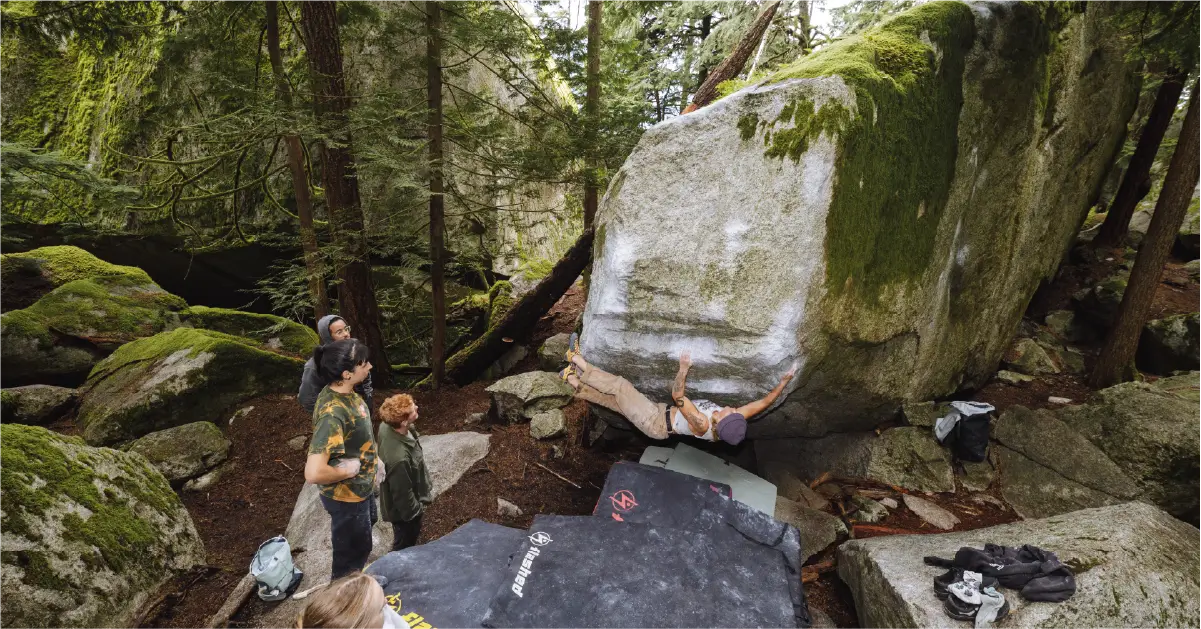
Rain-Forest Granite Under Coastal Skies
Climate & Season
Squamish sits at sea level yet benefits from maritime air-conditioning: daily highs hover around 75 °F (24 °C) and forest canopies keep blocs perpetually shaded. Summer mornings are often dry, with afternoon sea breezes whisking humidity away, though rainstorms can roll in without warning.
Stone & Style
Coarse, glaciated granite yields everything from balancy slabs to roof cracks. Stout compression features have spawned a reputation for sandbag grades—but the movement is always rewarding.
Must-Climb Classics
- Superfly V4—techy arete that epitomizes Squamish footwork.
- Sloppy Poppy V4—powerful compression in the Dreamcatcher area.
- Encore Une Fois V11—world-class strength-to-length test-piece.
Guidebook & Beta
The 4th Edition of Squamish Bouldering (2019, Quickdraw Publications) maps 3,500+ problems with colour topos and updated access notes (rockandsnow.com). For granular updates and nearly 4,000 problems, the 2023 KAYA digital guidebook adds offline GPS and community beta videos (mountainproject.com, gripped.com).
Logistics & Challenges
Rent pads in town (Climb On, Squamish Mountain Shop) and skip airline oversize fees. The Stawamus Chief Campground is first-come-first-served and usually fills by mid-morning on summer weekends; reserve Alice Lake, Porteau Cove or other area campgrounds months ahead if you need a guaranteed site. Camping in Smoke Bluffs Park or other municipal green-spaces is prohibited. Local ethics: brush all chalk, keep music low near neighborhoods, and tread lightly on the mossy forest floor. Insect repellent is wise—mosquitoes and no-see-ums peak in late July.
Learn more about Squamish bouldering by heading over to our post.
Rocklands, South Africa
Winter Wonderland in the Southern Hemisphere
Climate & Season
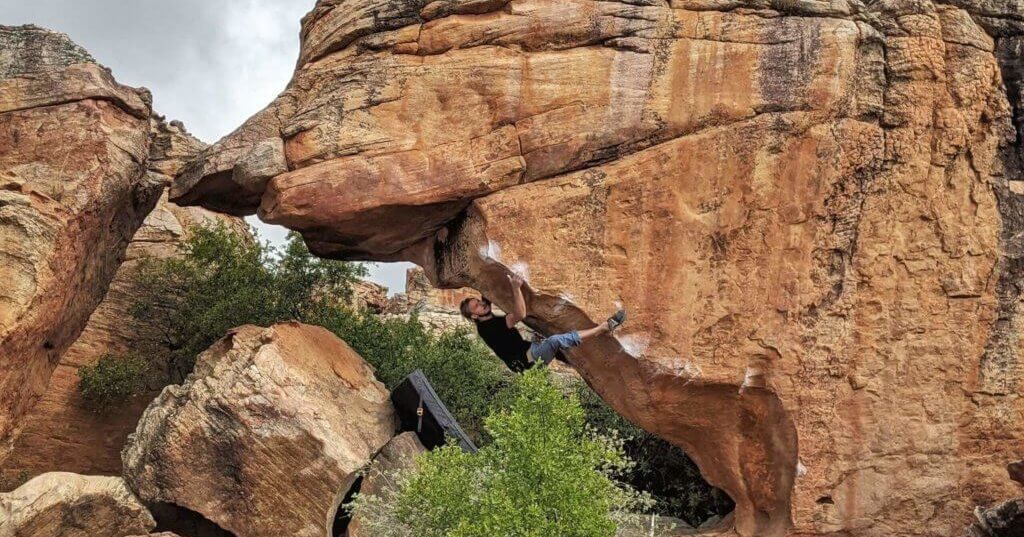
While North America bakes, the Cederberg Mountains slip into dry, sunny winter. Daytime temps hover around 55–70 °F (13–21 °C) with single-digit humidity, yielding velcro friction on the orange and grey sandstone. Nights are cold—sub-freezing in July—so plan sessions for the sun and pack a down parka.
Stone & Style
Hard, iron-rich sandstone has eroded into steep roofs, improbably featured faces, and juggy highballs on bullet patina. Movement ranges from thuggy heel-hooks to delicate paddle dyne moves.
Must-Climb Classics
- Cedar Spine V9—50-foot patina romp above cushioned landings.
- Black Shadow V12—the line that launched Rocklands onto every strong climber’s bucket list.
- El Corazón V13—Daniel Woods’ sweeping 45-degree masterpiece.
Guidebook & Beta
The out-of-print 3rd Edition Rocklands Bouldering is being revised, but you can grab the comprehensive digital guide via the 27 Crags app, or purchase local print copies on arrival at De Pakhuis campsite or in Clanwilliam (instagram.com, rocklands.africa).
Logistics & Challenges
Expect a 3 h 30 min drive (256 km) from Cape Town; a rental car is essential. Buy your daily CapeNature permit online or at the Kliphuis/ de Pakhuys offices before entering the blocs. Both farms (and Alpha Excelsior) rent crash pads—reserve ahead in July–August high season. A March 2025 wildfire closed several sectors; check CapeNature’s closure map and obey fire bans. Pack out all trash, brush holds gently—patina is fragile—and carry extra tape for the thorny fynbos approaches.
Learn more about Rocklands bouldering by heading over to our post.
Final Thoughts
Bouldering in summer doesn’t have to mean greasy slopers and midday siestas. By trading sea level for sapphire skies—or flipping hemispheres altogether—you’ll find crisp rock, expansive landscapes, and a fresh perspective on what the season can offer. Telluride rewards the adaptable climber with five rock types in a single weekend; Rocky Mountain National Park delivers alpine grandeur alongside world-class difficulty; Squamish wraps you in a temperate rainforest where classics outnumber rest days; and Rocklands offers a sandstone dreamscape just when you thought summer was doomed to gym plastic.
Wherever you roam, check local access updates, minimize your footprint, and remember that the journey is half the story. Pack the guidebook, load the pads, and chase that perfect summer friction—your next project awaits in cooler air.